

Car Insurance Claim
Car Insurance Claim Documents Checklist: What You Need for Accident, Theft, and Third-Party Claims
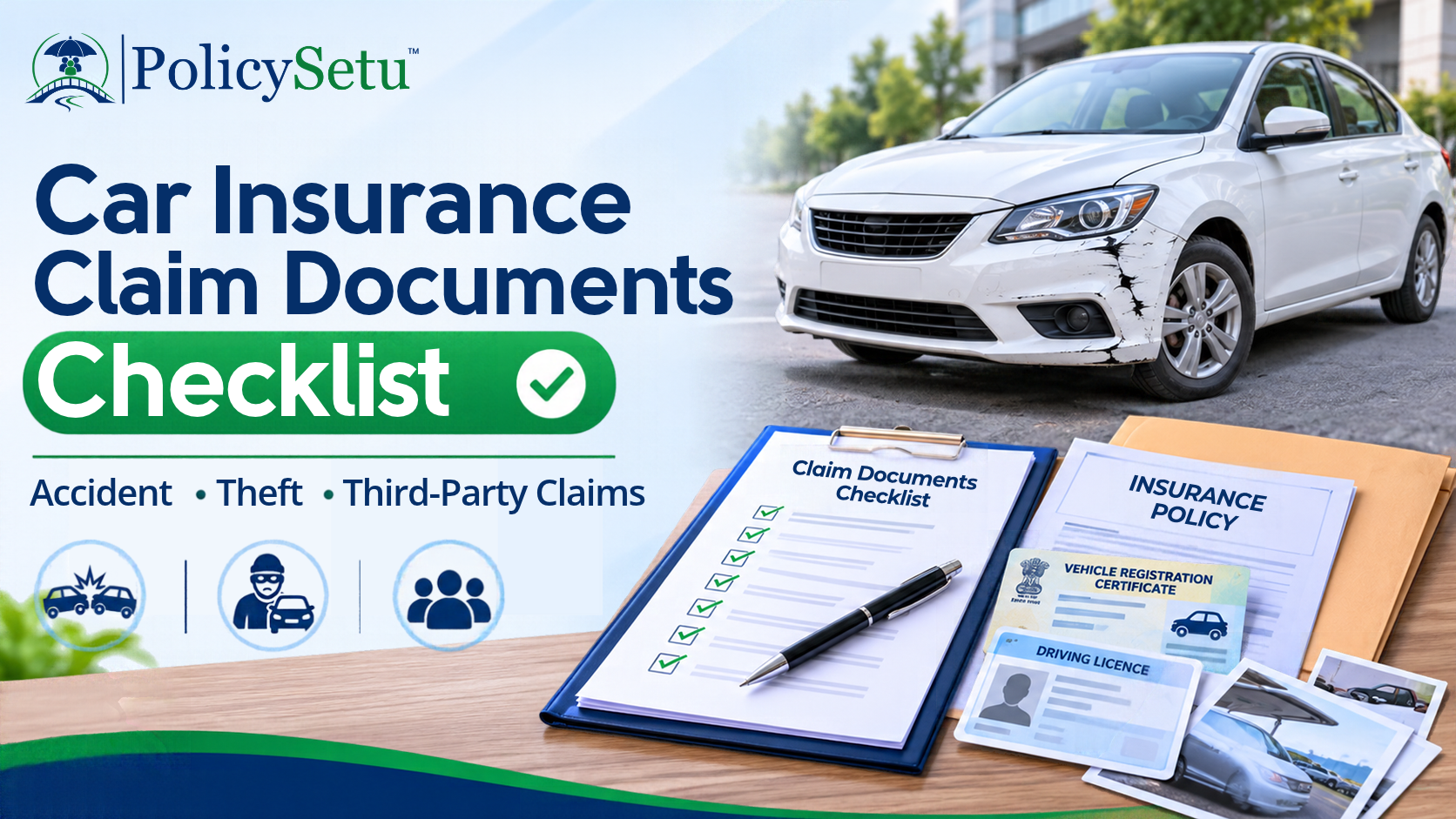
Complete checklist of car insurance claim documents required for accident, theft, cashless, and reimbursement settlements in India, plus when an FIR is mandatory.
The core documents required for any car insurance claim in India are the completed claim form, a copy of the vehicle Registration Certificate (RC), the driver's licence of the person driving during the incident, the active insurance policy schedule, and clear photographs of the vehicle damage. An FIR is legally mandatory only for theft, bodily injury, third-party property damage, or fire, while minor own-damage accident claims settled at authorized network workshops typically do not require police involvement.
An accident or vehicle breakdown is stressful enough without the added burden of missing paperwork. In India, incomplete or incorrect documentation is one of the single biggest reasons car insurance claims are stalled, queries are raised, or settlements are delayed by weeks.
Whether you are filing an own-damage claim after a minor fender-bender, organizing bills for a reimbursement repair, or handling the complex paperwork of a vehicle theft, having an organized document dossier changes everything.
This practical checklist covers the exact car insurance claim documents required for every claim type, explains when an FIR is mandatory versus optional, and highlights common documentation mistakes that lead to claim rejections.
1. Primary Car Insurance Claim Documents (Required for Every Claim)
Regardless of whether your claim is settled through a network workshop or reimbursed later, your insurer will require this fundamental document package before assigning a surveyor:
- Completed and Signed Claim Form: This is the formal intimation document detailing the date, exact time, geographic location, and a factual description of how the collision or damage occurred. Ensure every field matches your supporting records.
- Vehicle Registration Certificate (RC): A clear, self-attested front-and-back copy of your RC smart card. If your physical RC is lost, a digital copy verified via the DigiLocker or mParivahan app is legally valid under Ministry of Road Transport and Highways (MoRTH) guidelines.
- Driver's Licence (DL): A copy of the valid driving licence belonging to the person who was operating the vehicle at the exact time of the accident. The licence category must match the vehicle class (e.g., LMV for private passenger cars).
- Active Policy Schedule: A copy of your valid comprehensive, own-damage, or third-party insurance policy showing active policy dates, Insured Declared Value (IDV), and endorsed add-on covers.
- Photographic & Video Evidence: Clear, high-resolution photographs and videos of the damaged vehicle taken from multiple angles at the accident spot before the car is moved or dismantled.
2. Additional Documents for Own-Damage & Cashless Repair Claims
If your vehicle has sustained accidental damage and is being repaired at an authorized network garage, you will need the following supporting workshop records:
- Detailed Garage Repair Estimate: An itemized, line-by-line cost projection prepared by the workshop technician detailing estimated labor charges, metal repair, and spare part replacement costs.
- Workshop Job Card: The official intake document issued by the garage confirming the date and odometer reading when the vehicle was checked in.
- Spot Survey Report: If the damage occurred on a highway or involved severe mechanical breakdown requiring on-site inspection, keep the surveyor's preliminary spot report handy.
For a comprehensive walkthrough of the end-to-end filing timeline, refer to our detailed step-by-step guide on how to claim car insurance in India.
3. Mandatory Documents for Reimbursement Claims (Non-Network Garages)
When you choose to repair your car at an independent, non-network garage, you pay the bills upfront and seek reimbursement from your insurer later. Because the insurer cannot monitor repairs in real time, documentation standards are stricter:
- Original Itemized Tax Invoices: Official GST invoices clearly showing part numbers, part descriptions, labor charges, and applicable tax rates. Carbon copies or handwritten estimate slips are routinely rejected.
- Original Payment Receipts: Proof of payment bearing the garage's official stamp and authorized signature, confirming the bill has been settled in full.
- Pre-Repair and Post-Repair Photographs: Photographic proof showing the vehicle before repair, during repair, and after completion with the vehicle registration plate clearly visible.
- Salvage Handover Acknowledgment: If high-value parts (like bumpers, windshields, or headlights) were replaced, the insurer may ask you to return the damaged salvage or deduct its agreed scrap value from your final payout.
- Bank Mandate & Cancelled Cheque: A personalized cancelled cheque or bank passbook copy displaying your name, account number, and IFSC code for direct electronic fund transfer (NEFT).
4. Documents Required for Total Loss & Vehicle Theft Claims
Vehicle theft and Constructive Total Loss (CTL) claims require the most extensive documentation, involving both civil police authorities and the Regional Transport Office (RTO):
- Copy of the First Information Report (FIR): Filed immediately at the nearest police jurisdictional station under Section 379 of the Indian Penal Code (IPC).
- Final Police Investigation Report (Non-Traceable Certificate): The court-accepted final untraced report (Form 173 CrPC) confirming that the vehicle could not be recovered despite investigative efforts.
- All Original Ignition Keys: Both original physical car keys (including key fobs). If a spare key was lost earlier, a formal police diary entry or written declaration explaining the loss is mandatory.
- RTO Transfer & Cancellation Forms: Duly signed Form 28, Form 29, Form 30, and Form 35 (to facilitate vehicle de-registration or transfer of title to the insurer).
- Financier NOC: If the car is under hypothecation or an active auto loan, a formal No Objection Certificate and loan foreclosure statement from your lending bank are required before the claim payout can be disbursed.
5. When Is an FIR Mandatory for a Car Insurance Claim?
A common question among vehicle owners is whether a police FIR is compulsory for every insurance claim. The rules are clear:
Cases Where an FIR Is Strictly Mandatory
- Vehicle Theft: You cannot initiate or settle a theft claim without a registered FIR.
- Third-Party Accidents: Any incident involving injury, death, or damage to another person's property requires an FIR to initiate Motor Accident Claims Tribunal (MACT) proceedings.
- Hit-and-Run Incidents: Accidents where the offending driver flees the spot or causes major public property damage.
- Vandalism, Riots, or Fire: Arson, civil unrest, or malicious property damage requires a police inquest report.
Cases Where an FIR Is NOT Mandatory
- Minor Own-Damage Accidents: Scrapes against a pillar, parking lot dents, broken windshields from flying gravel, or single-vehicle collisions where no third party or bodily injury is involved. In such cases, submitting detailed accident photos and your signed claim form directly to the surveyor is sufficient.
6. Top 5 Documentation Mistakes That Cause Claim Delays
Avoid these common paperwork oversights to ensure your settlement is processed without friction:
- Driving Licence Mismatch: Submitting a licence that expired before the accident date, or holding an LMV (Light Motor Vehicle) non-transport licence while operating a commercial transport vehicle.
- Discrepancy in the Accident Narrative: Giving one version of the incident in the claim form and a conflicting account in the garage job card or police diary entry. Keep your narrative factual, consistent, and concise across all records.
- Commencing Repairs Before Survey Completion: Allowing the workshop to dismantle damaged panels or begin bodywork before the insurance surveyor has completed the physical inspection.
- Unstamped Garage Bills: Submitting informal workshop receipts lacking GST numbers, repair serial numbers, or official authorized signatures.
- Missing Add-on Endorsements: Claiming replacement costs for consumables (engine oil, nuts, bolts, coolant) without verifying whether your policy schedule includes an active Consumables Cover.
7. What to Do If Your Claim Is Disputed or Stalled Over Paperwork
Insurers sometimes raise repetitive, unreasonable document queries or issue formal rejection letters citing technical non-compliance. If your paperwork is in order but the insurer refuses to process your claim:
- Request a formal query letter stating the exact regulatory clause or policy condition under which additional documents are demanded.
- Review your case against our guide on how to escalate a rejected claim without panic to understand your statutory consumer rights.
- If the insurer issues an unfair repudiation or deductions, file an appeal with your insurer's Grievance Redressal Officer (GRO) or prepare an application for the Insurance Ombudsman and Lokpal framework.
- For personalized, hands-on assistance with surveyor disputes, delayed intimation queries, or complex theft documentation, reach out to PolicySetu's dedicated motor insurance claim support team.
Frequently asked questions
Can I submit a DigiLocker driving licence for my car insurance claim?
What happens if I lose one of my car keys in a theft claim?
Is an FIR needed if my parked car was damaged by an unknown vehicle?
Can an insurer reject my claim if I submit documents after 30 days?
Related on Policy Setu
Need help with your claim?
Talk to Policy Setu for clear next steps on your policy or claim.
Need Help With Your Car Insurance Claim Paperwork?